Why Unibloom
Accessible, easy to use, fast.
Priced for every team
From €50 per user a month. No commitment, cancel anytime.
No IT project
Upload your report and that’s it. No integrations, no approvals required. Just get started.
In minutes, not months
Your plan in 10 minutes, with automated data instead of months of manual work.
How we compare
Unibloom vs. others.
| Unibloom | Others | |
|---|---|---|
| Price | From €50 per user a month, cancel any month | Consultancy projects or annual software licences |
| Getting started | Start your plan in 10 minutes, no IT project | Weeks of setup, integrations or consultant time |
| Who uses it | Sustainability, procurement, finance and R&D, from the same numbers | Usually only the sustainability team |
| What it shows | Carbon and cost on the same line, for every initiative | Tonnes of carbon |
| How often it changes | Change it on the spot and see it update live | Weeks to get updated results |
| Collaboration | Invite colleagues instantly and they see the plan update live, if you choose to share it | A plan kept in spreadsheets or with consultants |
| Where the numbers come from | Every number shows its source; estimates are labelled | Hard to trace once it is written |
Trusted by teams at





- 57projects from 12 departments in one placeCloetta
- 40companies, each with a plan of its ownWatch & Jewellery Initiative 2030
- 10countries, each with company-specific climate prioritiesBemsiq Group
Why we do this
To turn climate ambitions and targets into action that makes business sense.
Born from the struggle to bring climate impact and the business case together, Unibloom’s proprietary models deliver data faster, cheaper and to more people in your company.
Auditable data aligned with ISO standards 14040 and 14044.
In our customers’ own words
We had group ambition and baseline data, but each of our 10 companies needed its own starting point. Unibloom gave us both the structure and the data-backed alternatives to build company-specific, costed action plans. In two 55-minute online sessions, every company was engaged and left with clarity on what they own in 2026.
Unibloom’s platform identifies a significant gap that we currently face between target setting, planning for target execution and investments needed.
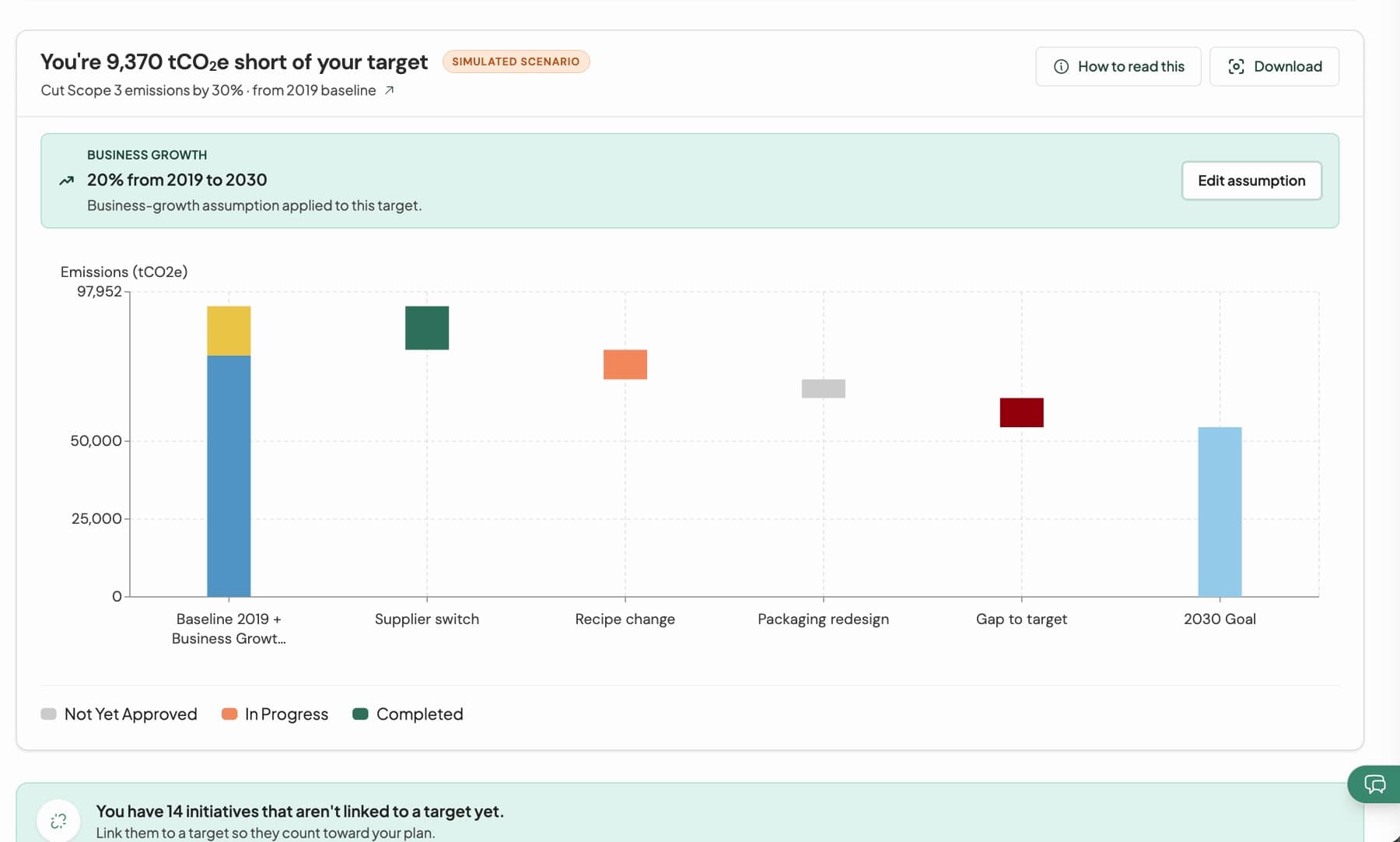
Unibloom’s platform supports in visualizing gaps, scenario plan and calculate forecasts to reach Science Based Targets. Investments needed for the climate journey are also visualized and gives the organisation input for decisions.
48+
projects, 7 functions and 9 stakeholders in one place
Scandi Standard brought its SBTi targets and initiatives together, and compared CapEx against OpEx for each one in the same view.
Choosing Unibloom: questions people ask
How is Unibloom different from carbon accounting software?
Carbon accounting software tells you what you emitted, for reporting. Unibloom tells you what to do about it: which initiatives, suppliers or ingredients close your gap to target, and what each one costs. Most Unibloom customers keep their carbon accounting tool and run both side by side.
Does Unibloom replace a sustainability consultant?
No. Consultants set the direction and bring expert judgement; Unibloom holds the plan between engagements and keeps it current. Unibloom has teamed up with 2050 Consulting, so you can add expert support to your Unibloom Climate Transition Plan whenever you need it.
Why do country-specific emission factors matter?
The same crop or material can have a very different footprint depending on where it was grown or made, because of land use, farming practices and the local energy mix. A global average hides that difference. Unibloom's data keeps the country of origin, so sourcing decisions reflect it.
Which industries is Unibloom built for?
Unibloom was built for food and consumer goods, where agriculture, land use and long supply chains make Scope 3 hardest to measure. The same approach and traceability work for other industries, from packaging to fashion.
Build a plan you can explain and keep improving.
Explore the platform yourself or talk through your requirements.