The most affordable supplier today can become the most expensive tomorrow
Carbon Pricing
Procurement, innovation, and marketing all face decisions they can no longer postpone. And why the numbers behind them are changing faster than most teams realise. Starting 27 September 2026, EU Directive 2024/825 requires verified, independent data behind any "sustainable," "climate-neutral," or "green" claim. Any company still making environmental claims without verified numbers will need to either prove them or stop.
But the regulation is only part of what is shifting. The bigger change is already inside your supply chain.
What makes it important to focus on your emissions and cost in your supply chain (Scope 3)?
26× — higher supply-chain emissions compared to your own operations (CDP / BCG 2024)
4× — more likely to reach Scope 3 targets with internal carbon pricing (CDP / BCG 2024)
Sep 2026 — EU law requires verified data behind every green claim (Directive 2024/825)
What procurement see and might miss
Today, most procurement teams optimise for one number: price per kg. It is simple, comparable, and easy to defend internally. But it does not capture the total cost. Supply-chain emissions are, on average, 26 times higher than a company's own operations. Several of your largest customers are already asking suppliers for that data: actual numbers, per product, per ingredient, per origin.
CO₂ price — The direct cost of carbon, built into contracts, border adjustments, and internal budgets. Growing every year.
Regulatory risk — Retailer demands, customer requirements, new legislation. Each with its own deadline.
When the total cost is ranked, prioritisation change
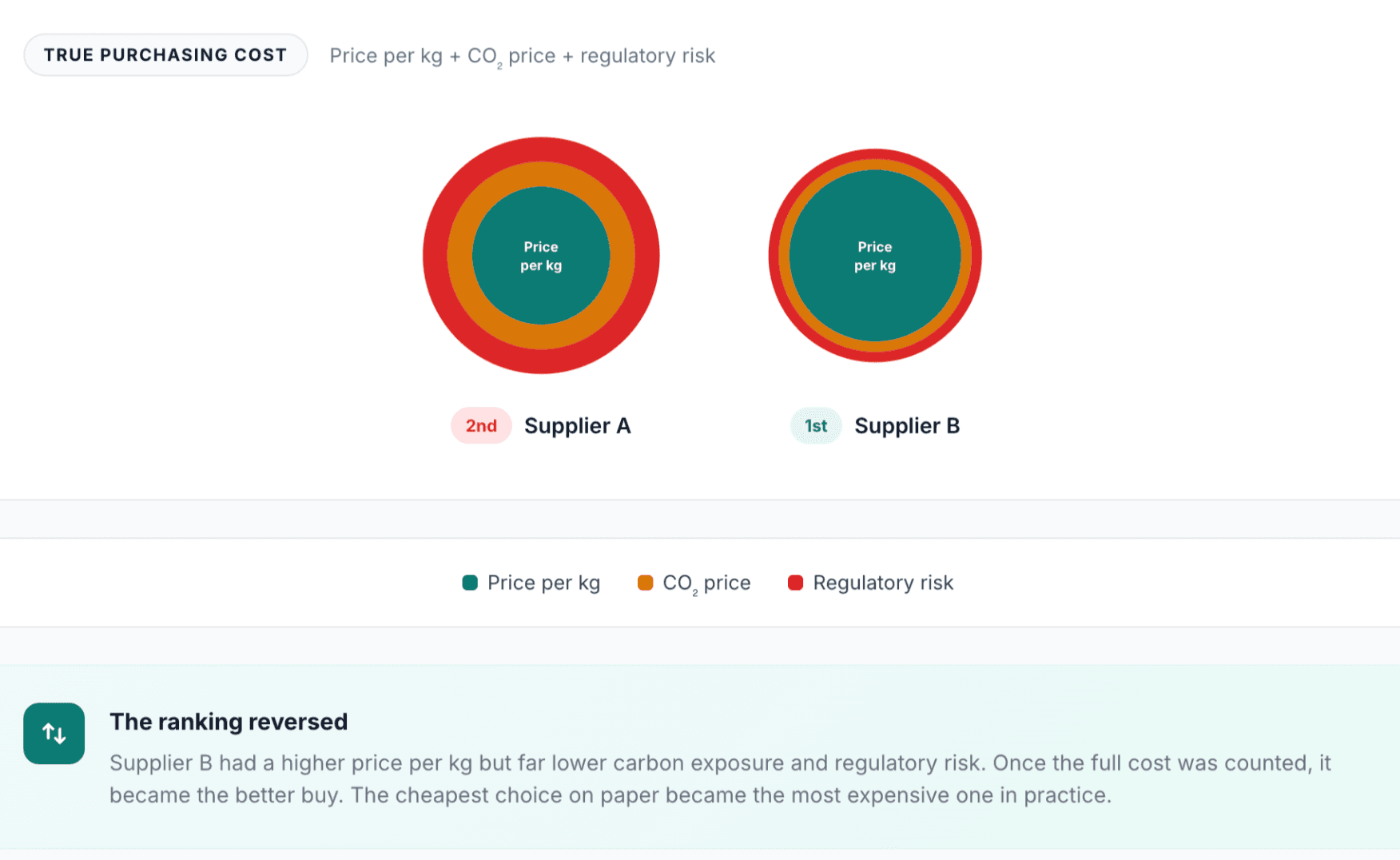
From a carbon pricing analysis: the supplier ranked first on price becomes the most expensive once CO₂ cost and regulatory risk are added. The circle size shows the total cost (see above).
BEFORE — Price per kg (what procurement sees today)
1st: Supplier A
2nd: Supplier B
↓ Total cost ↓
AFTER — True purchasing cost (price per kg + CO₂ price + regulatory risk)
1st: Supplier B
2nd: Supplier A
Price per kg / CO₂ price / Regulatory risk
The prioritisation change
Supplier B has a higher price per kg but far lower carbon exposure and regulatory risk. Once the total cost is counted, it becomes the better buy. The cheapest choice on paper becomes the most expensive one in practice.
Carbon pricing is the new guiding principle
Companies that have introduced internal carbon pricing are 4 times more likely to reach their Scope 3 targets (CDP / BCG 2024). That is not coincidence. It means the total cost is built into every sourcing decision from the start. The companies doing this now are building a structural advantage over the ones waiting for the requirement to arrive.
"The cheapest per kg becomes the most expensive once the total cost is counted in."
— From SPP carbon pricing analysis (https://www.spp.earth/initiative/carbon-pricing-for-procurement/)
What can this mean for your team
For procurement: the scorecard for supplier selection needs a CO₂ column and a regulatory exposure column. Price per kg is a starting point, not the finish line.
For innovation: reformulation decisions made today will determine which products can still carry sustainability claims from September 2026.
For marketing: from September 2026, every "green" claim on a label requires independent, verified data behind it. Aspirational language without proof becomes a compliance liability.
Let's get started
Run your own supplier comparison with Switch, or try the Cost of Inaction from Unibloom which encounter carbon pricing, or find Unibloom on SAP Store to connect emissions data directly to your procurement workflow.
Try Switch: https://switch.unibloom.world/input
View on SAP Store: https://www.sap.com/products/scm/partners/unibloom-world-ltd-unibloom-data-intelligence-granular-scope-3-in-supply-chain-flag-cost-performance-data.html?countryCode=US
Let's chat to learn how we can help you
How does your supplier assessment hold up when the total cost is counted in? We'd be happy to show how others in your industry are answering this, and what country specific ingredient-level emissions data looks like for your product mix - when your primary data is missing and it will take you years to get it (if at all).
Book a 30-minute call: anna.sandgren@unibloom.world or calendly.com/anna-sandgren