Precision Fermentation Proteins: Lower Emissions, Same Function — What Procurement Needs to Know
Food systems


Global dairy production is one of the biggest emitters and land users on the planet. Precision fermentation offers a radically different path — and companies like Curve Biotech AB are building the infrastructure to scale it.
Every litre of cow's milk that makes it into your fridge carries a hidden cost — one that doesn't appear on any price tag. These include land use for feed crops, water use and methane produced by the cow. Considering the size of the diary industry, it isand you've got one of the most emissions-intensive sectors with the highest emissions in global food production.
The scale of the problem is hard to grasp. Three numbers might help:
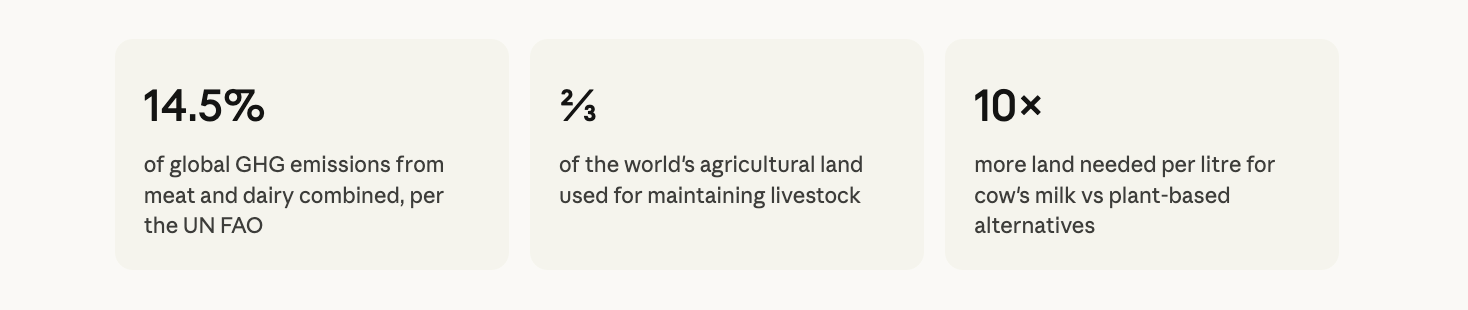
Sources: FAO, Our World in Data, https://ourworldindata.org/environmental-impact-milks
The dairy sector alone accounts for roughly 4% of total global greenhouse gas emissions — more than the emissions from aviation. Those emissions accumulate across enteric fermentation (the methane cows produce while digesting), manure management, feed crop cultivation using fossil-fuel-derived fertilisers, and land-use change (e.g. from forest to pasture).
Meanwhile, the global food system can be fragile and is often affected by current events and climate volatility. Fertiliser prices have spiked recently due to energy prices and supply chain disruptions in the Middle East. The disruption of Ukrainian grain and fertiliser supplies in 2022 also revealed a structural vulnerability in the global food system. The current ways of supplying the global population with the protein we need overly rely on traditional systems that strain natural resources and can damage the environment,and new technology is essential to deliver what our world needs, at scale, with minimal impact.
How precision fermentation compares to plant-based, insect, and microbial proteins on cost and emissions
Several approaches are competing to reduce the footprint of proteins and functional enzymes like rennet. Here's an honest assessment of each:
1. Plant-based proteins
Established
Proteins extracted from peas, soy, oats, or rice. Lower emissions than dairy, but not functionally equivalent — they can't replicate casein's melting behaviour in cheese or whey's foam stability in sports nutrition. And soy monocultures carry their own deforestation risk.
Emissions (indicative range): 0.5-3.0 kgCO2e/kg of agricultural product
Cost (indicative range): €3–7/kg for soy and pea proteins, much higher for specialty proteins
Limitations: Functional gap in the use of plant proteins; some crops (e.g. soy) may carry land-use and deforestation risks.
2. Traditional microbial fermentation
Proven
Fungi or bacteria ferment substrates to produce protein-rich biomass (e.g. mycoprotein) or bulk enzymes. Much lower emissions than dairy and can scale well. But it produces from microbes — it doesn't program them to make specific dairy proteins. The functional result is different.
Emissions: 0.5 kg CO2e/kg for some mycoprotein products
Cost: Proven cost competitiveness with mycoprotein products available on the market
Limitations: Not functionally identical to dairy proteins, as the microbial biomass itself is the product rather than a microbe programmed to produce a specific target protein
3. Insect-derived proteins
Emerging
Black soldier fly larvae convert organic waste into protein-rich meal. Strong sustainability credentials and a shrinking cost curve. But primarily suited to animal feed rather than direct dairy protein applications — the functional protein profile doesn't match casein or whey.
Emissions: Generally lower than most conventional protein sources but dependent on insect feed and rearing practices (Siddiqui et al., 2024)
Cost (indicative range): €5–12/kg
Limitations: Not suitable for direct human consumption; functional gap; social and legal barriers
4. Microalgae and single-cell protein
Emerging
Microalgae (Spirulina, Chlorella) and hydrogen-oxidising bacteria like Solein can produce protein with extraordinarily low inputs — some using only CO₂ and renewable electricity. Impressive on emissions, but not functionally equivalent to dairy proteins, and costs remain high.
Emissions: potentially very low, especially in low-carbon electricity-based systems
Cost: High and not yet at commercial maturity; costs depend heavily on organism, cultivation system, downstream processing, and scale
Limitations: Low economic feasibility at current state of the technology; functional equivalence gap
5. Precision fermentation
Featured solution
In precision fermentation, microorganisms are programmed with the exact gene sequence for a target protein — say, beta-lactoglobulin (whey) or alpha-casein. They produce it during fermentation; the protein is then isolated and purified. The result is molecularly identical to animal-derived protein with the same functional behaviour in food. No cow required.
This is not theoretical. Chymosin — the enzyme that makes cheese set — is already produced this way, accounting for an estimated 70–90% of all chymosin used in cheese manufacturing globally. Regulatory approvals for precision fermentation whey protein have been granted in the US, Canada, and Israel. Casein approvals are following.
Emissions: Up to 70% less greenhouse gas emissions, 95% less land and 80% less water when compared to similar animal proteins from eggs and diary (GFI Europe)
Cost: Currently higher than conventional proteins but declining with scale
Limitations: Cost barrier and regulatory approval for certain applications
The case for precision fermentation
Precision fermentation combines the process of traditional fermentation with the latest advances in biotechnology to efficiently produce a compound of interest — such as a protein, flavour molecule, vitamin, pigment, or fat. (Lajnaf, 2025)
Think of it like a brewery where yeast converts sugar into alcohol. Precision fermentation uses the same basic process — a microbe, a nutrient feedstock, a bioreactor — but swaps the output. Instead of alcohol, the microbe produces whey protein. Or casein. Or lactoferrin. Or rennet. The microbe is the factory; the gene sequence is the instruction manual.
What makes this genuinely different from every alternative above is functional identity. When a precision fermentation producer makes beta-lactoglobulin, it is the same molecule a cow makes — it foams the same way, gels the same way, interacts with calcium the same way. A food manufacturer can substitute it into an existing recipe without fundamentally redesigning the product. That's something plant protein, insect meal, or algae cannot yet across the full range of dairy applications.
Where Curve Biotech AB fits in
The potential of biomanufacturing is clear — but scale has been the bottleneck. That's exactly the problem Curve Biotech AB is trying to solve.
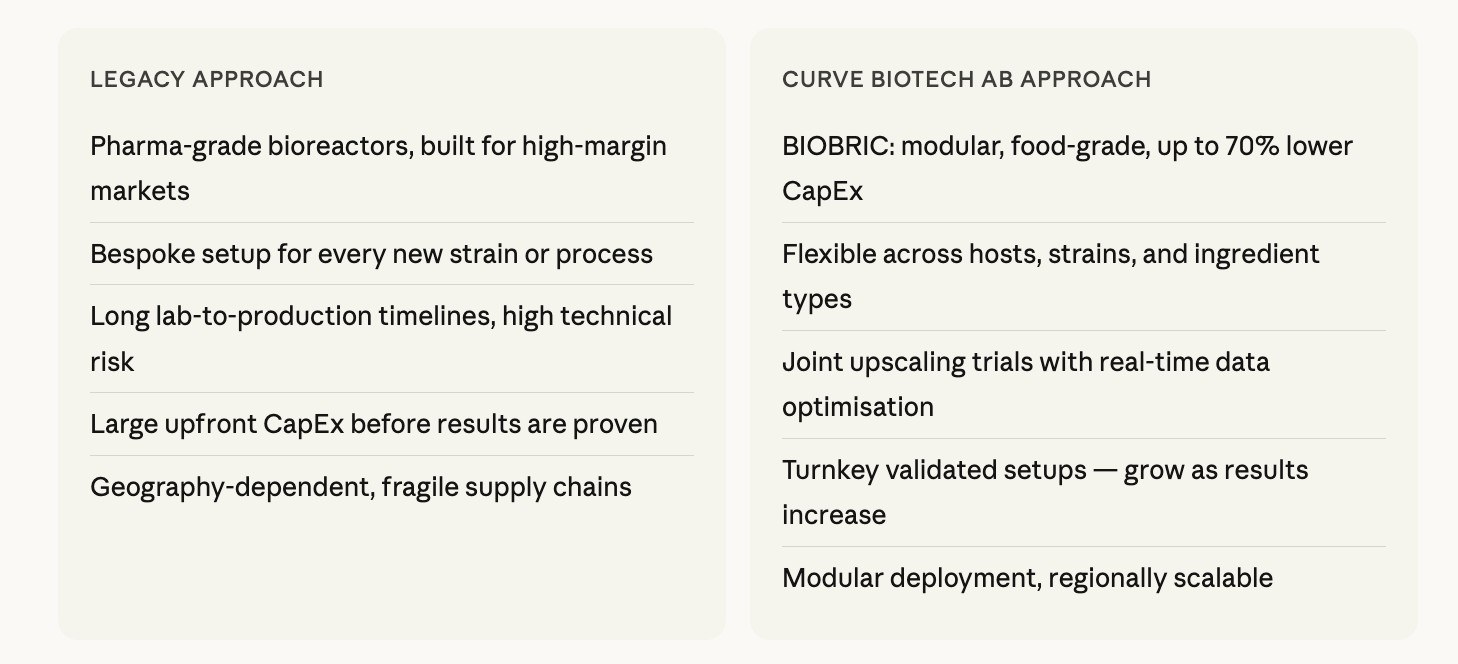
Based in Malmö, Sweden, Curve combines expertise in engineering, biology, and biochemistry to create robust, modular production systems for precision fermentation and cell cultivation — spanning food and health to chemicals and sustainable materials. Their core technology, BIOBRIC, is designed to bridge the gap between basic food-grade fermenters and costly pharma-grade bioreactors: the equipment traditionally built for pharmaceutical margins, not the cost dynamics of food, cosmetics, or functional ingredients.
"Scaling biotech is the next industrial revolution — but it demands tools built for this century, not the last. At Curve, we're developing intelligent systems that unlock the potential to make biomanufacturing commercially scalable."
— Jacob Schaldemose Peterson, Co-founder & CEO, Curve Biotech AB
BIOBRIC is engineered for bioprocess flexibility and continuous optimisation. It combines physical hardware with data-driven simulations to enable optimised conditions, strain learning, and automated process refinement — improving yield, stability, and cost-efficiency at every run. It supports a wide range of microorganism hosts, from yeast, bacteria, and fungi to mammalian cells, and works across a wide range of bioidentical ingredients, including proteins, lipids, sugars, pigments, collagen, and more.
The difference shows up in the numbers:
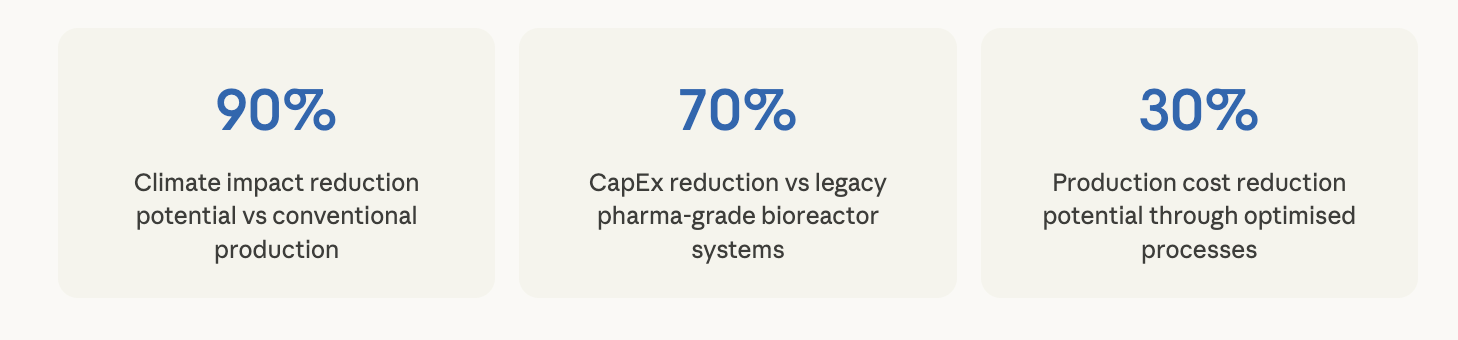
Curve's collaboration model is equally important to the technology itself. Scaling biomanufacturing is not a solo act — it's a collaboration between innovators, engineers, and operators. Curve works alongside pioneering precision fermentation companies, running joint upscaling trials that refine strains, media, and processes using BIOBRIC. Each iteration strengthens performance and economics, laying the groundwork for commercial manufacturing. Once optimised, validated setups are licensed to established producers ready to scale. This model reduces technical risk, accelerates market entry, and makes advanced biotech accessible to industries worldwide — without requiring pharma-level budgets to get started.
Seeing the switch in data — what Unibloom's solution shows to choose the right solution and supplier with validated science backed data
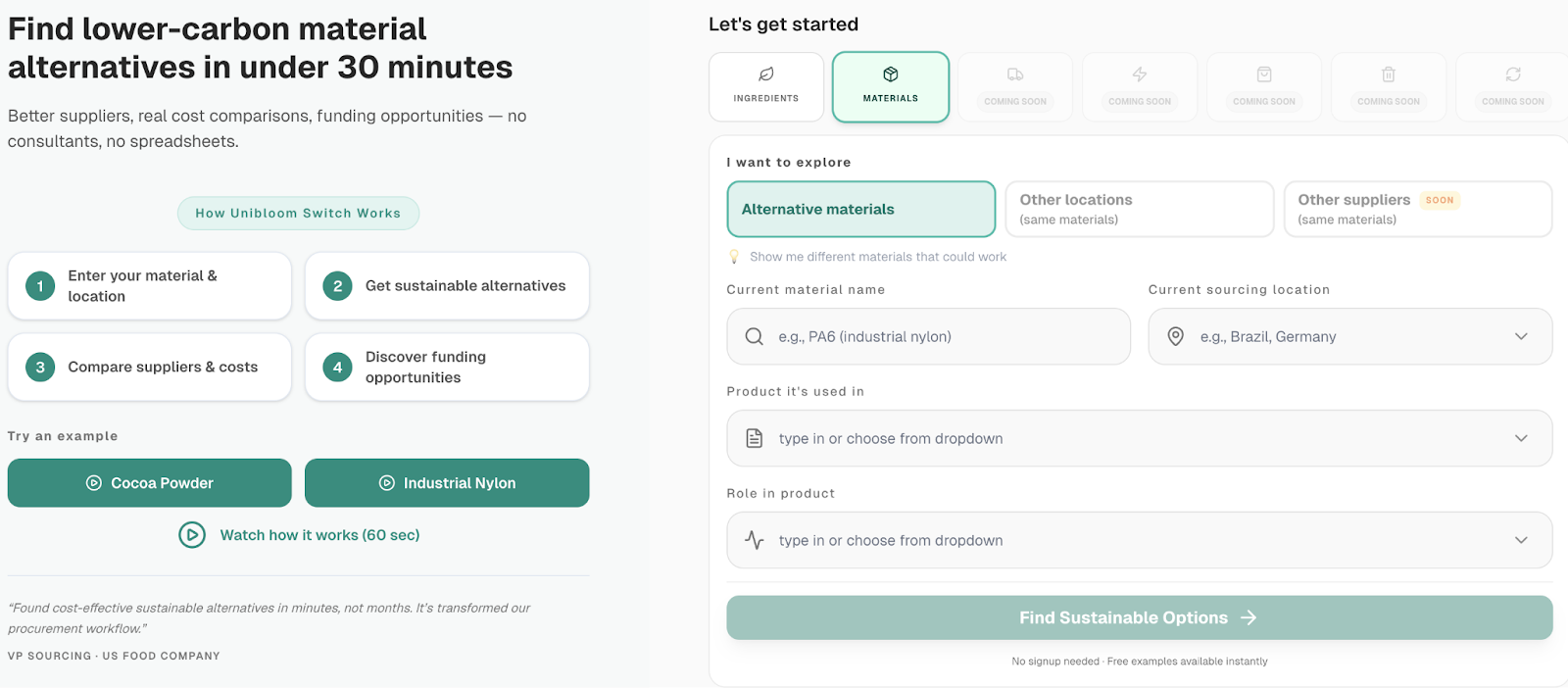
Knowing a potential solution to switch to is one thing. Knowing the cost and emissions trade-off in real numbers — instantly, side by side — is another. That's the gap Unibloom Switch is built to close.
Unibloom is an intelligent climate and cost simulation platform built for food and consumer goods companies. Its Switch tool lets procurement, sustainability, and R&D teams model ingredient swaps instantly — filling data gaps with Unibloom's own databases and web-sourced data, then placing emissions and cost comparisons side by side so every function acts from the same evidence.
No months of IT approvals, no manual spreadsheets, no chasing suppliers for data that may never arrive. Alongside each scenario, it automatically surfaces relevant grants, subsidies, and certified supplier matches — turning a comparison into an action plan.
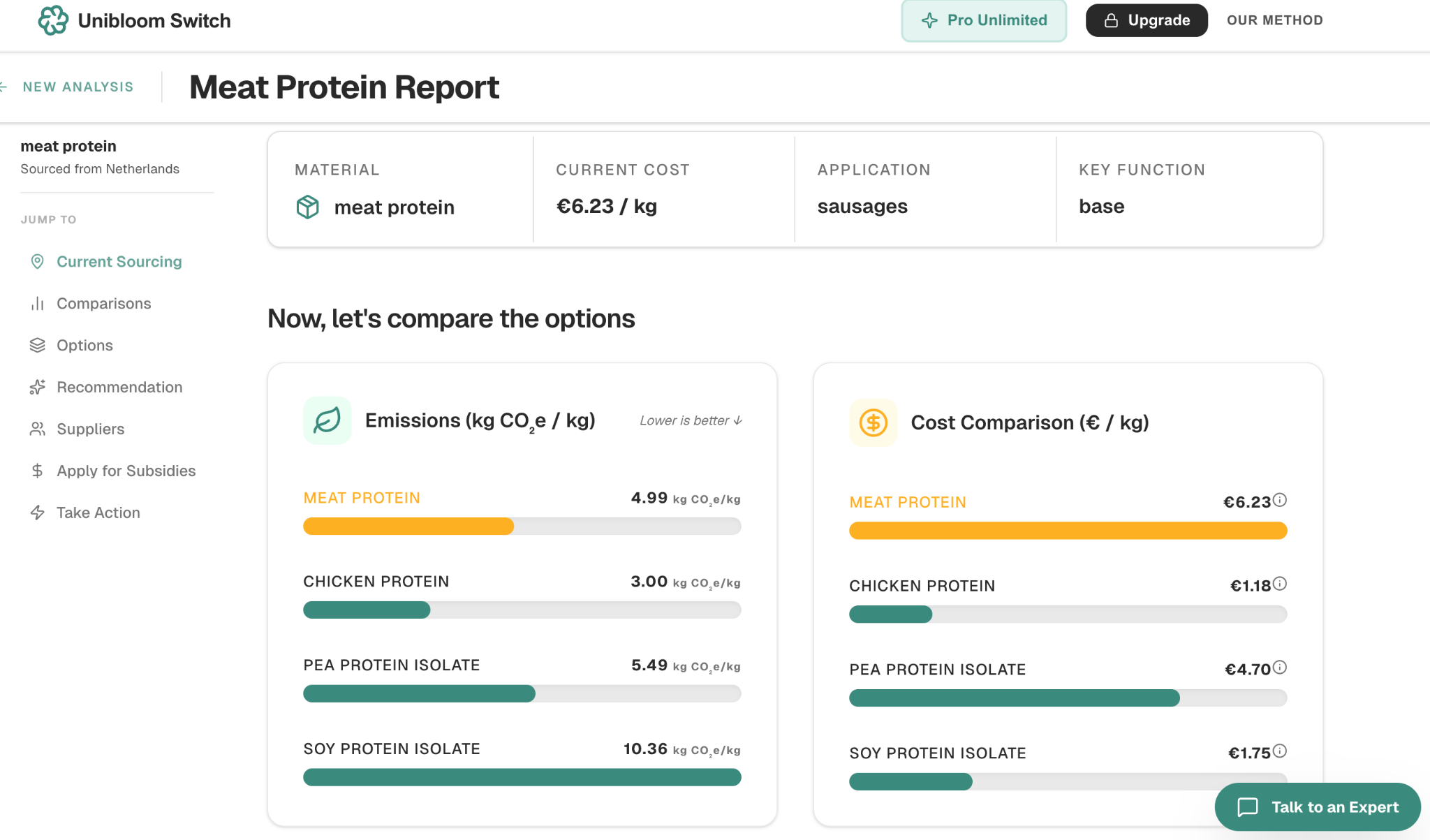
While precision fermentation is far and away the best option on emissions for producing bioidentical ingredients like specific proteins, it carries a cost premium. For companies that need to demonstrate credible Scope 3 reduction plans — as increasingly required under CSRD, SBTi FLAG, and retailer sustainability commitments — tools like Unibloom Switch turn this tension into a concrete investment case rather than a theoretical argument.
Wht is the true cost
Precision fermentation proteins are currently more expensive than their conventional equivalents for most bulk applications — that's the honest truth. But the cost trajectory follows Wright's Law: costs are expected to fall as scale increases and the technology matures. For functional enzymes like chymosin, precision fermentation has already achieved cost parity — that's why it dominates the rennet market. For bulk proteins like whey, the gap is narrowing rapidly. The global precision fermentation market is projected to grow from $1.3 billion in 2021 to an estimated $34.9 billion by 2031.
The future, as Curve's own framing puts it, isn't built in labs — it's scaled through technology. Companies building the manufacturing infrastructure now are positioning themselves at the right moment. The ones that own validated, cost-competitive scaling platforms when the cost crossover happens will be extraordinarily well placed.
The bottom line
The growing global need for affordable, safe, and sustainable protein goes far beyond food — proteins fuel breakthroughs in healthcare, materials, nutrition, and animal feed. But current systems rely on traditional infrastructure that strains resources and limits innovation. Smarter protein production can unlock healthier living, greener industries, and a more resilient future for all.
Precision fermentation is the pathway that simultaneously achieves functional parity with animal-derived proteins, near-zero emissions, minimal land use, and supply chain controllability. The technology works. The question is mostly one of scale — and that's precisely the gap Curve Biotech AB was built to close. For companies that want to make that transition with confidence, Unibloom Switch provides the data to act today rather than wait for perfect certainty that never arrives.
Unibloom Switch tool lets procurement and R&D teams compare conventional dairy proteins against precision fermentation alternatives — side by side, with verified emission factors, cost per kg, and matched suppliers. Compare your first ingredient free →
Looking for organisations that help hit SBTi targets? See how Unibloom works →
Or,
Book a call with us: calendly.com/anna-sandgren
https://unibloom.world
Sources
1. Curve Biotech AB — BIOBRIC platform, key figures, and company mission: curvebio.tech
2. UN FAO — Livestock and climate emissions: Carbon Brief interactive
3. Our World in Data / Poore & Nemecek (2018) — Dairy vs alternative proteins: ourworldindata.org
4. WWF — Agricultural land use for livestock: worldwildlife.org
5. IntechOpen (2025) — Precision fermentation for dairy proteins: intechopen.com
6. ScienceDirect (2024) — Precision fermentation food proteins mini-review: sciencedirect.com
7. RethinkX (2024) — Precision fermentation and the dairy disruption: rethinkx.com
8. Food Processing (2024) — Chymosin market share and fermentation history: foodprocessing.com
9. GFI Europe — Environmental impact and regulatory landscape: gfieurope.org
10. Unibloom Switch — AI-powered ingredient scenario modelling: unibloom.world/uswitch